

HVDC
High Voltage Direct CurrentWhat does it do?
HVDC transmits great amounts of electrical power over long distances. Compared to alternating current, the direct current system is less expensive and loses less energy. HVDC can be transmitted through cables both underground and underwater.How does it work?
HVDC transmission utilizes a converter station at either end of the system. A mercury arc valve or solid state valve (thyristor) is used for the conversion of AC and DC current. The valve at the beginning of the system converts alternating current to HVDC, the HVDC travels to the next location through a cable, and the valve at the end of the system converts the HVDC back to alternating current.How will it be used in the future?
HVDC is being considered globally for renewable energy efforts. Since HVDC allows for more power to travel long distances with fewer lines and reduced losses, clean energy can efficiently travel to distant locations.Examples:
Wind farms located in the best natural wind areas of the Midwest could deliver power a few hundred miles by HVDC to Chicago or Denver.
Central Quebec has numerous hydroelectric generating stations in extremely remote areas which could send power directly to New York City or Boston.
History:
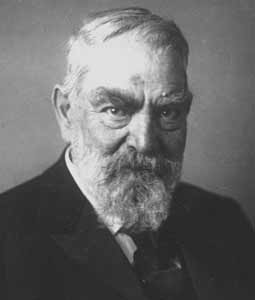
Oskar Von Miller, engineering pioneer and founder of the Deutsches MuseumEuropean Beginnings:
The first successful HVDC experimental long distance line (37 miles) was made at Munich, Germany in 1882 by Oskar Von Miller and fellow engineers. These same pioneers moved on to work on AC power the next year and did not do much in the HVDC field after that. Miller and associates pioneered AC power in the 1883-1890s era. Their important early DC work laid the foundation for future developments.
Later Work, US and Europe:Thomas Edison and fellow engineers worked on HVDC as part of a plan to make a standard DC "grid". AC power quickly proved to be easier to work with for long distance. The 1891 Electro-technical Exposition in Frankfurt, Germany was the definitive end of the war of currents, however a small number of people continued to develop DC transmission after this.
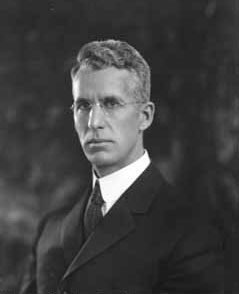
Albert Hull (General Electric)Albert Hull (GE) developed the thyratron, and used it on an experimental HVDC line near Mechanicville, NY in 1936, meanwhile in Nazi Germany engineers were making great advances in the field as well.
After the war companies like ASEA (today ABB) and Siemens were ahead in development and they developed the first HVDC lines to cross waterways like that between Sweden and Denmark. There was more of a market for HVDC in Europe and Japan since HVDC could deliver power under long waterways when AC could not. ASEA had also employed some of the original German HVDC pioneers after the war, giving them an advantage over competition. General Electric also was involved in making HVDC systems but exited the business in the 1980s.
1940 - First modern HVDC line was under construction between Dessau and Berlin, it was captured by the Russians and fully completed in 1951 between Kashira and Moscow.
1956 - First commercial HVDC Line Gotland to Sweden mainland. 100 kV
Resistance to HVDC:
Some US utilities have been and still are resistant to HVDC despite the advantage to the customers. The localized power providers do not want cheap energy coming in from outside their region. In New York State for example, unions of the local power production facility workers fight HVDC because it would mean lower energy prices and this would effect profits of local producers. Despite this resistance North America still has many HVDC lines and is installing more as time goes on.
ASEA had developed and implemented solid state switching in 1962. This was the future of HVDC. Today HVDC systems are highly advanced, safe, and have efficient solid state switching.
Terms of interest:
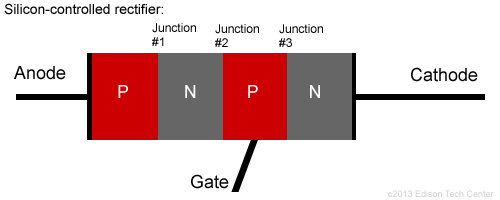
Thyristor - a semiconductor switch allowing power to flow in one direction only. In HVDC thyristors convert AC to DC power, or back to AC. The term thyristor is usually used to describe a switch with at least four layers of n and p-type material. Learn more about semiconductor switches here. In HVDC thyristors are placed in series in tall stacks, often hung off the floor in an enclosed building.
Mercury Arc Rectifiers - Glass envelopes which contained mercury, used for rectifying power. When the temperature would heat up enough to vaporize the mercury, current would pass through the tube through the vapor to the other side. It was replaced by the thyristor. Example uses: They were used to convert AC power to DC for the New York City subway system, and for early electric car chargers, as well as HVDC systems before the 1960s. See our page on these devices here.
Node - ending or starting point of an HVDC lineRectification - the passing of current in only one direction, thyristors will rectify AC into DC.
Related Subjects: History of Electrification, AC Power History
Featured Pioneers of HVDC:
Oskar Von Miller (1882 HVDC line to Munich)
Thomas Edison and company - experimented with HVDCGeneral Electric:
Albert Hull
Ernst Alexanderson
Bernie Bedford
Fred Ellert
Clarence Flairty
Glenn BreuerABB / ASEA:
Information is still being gathered
SIEMENS:
Information is still being gathered on pioneers
VIDEOS:
Glenn Breuer on the development of HVDC at GE and the world 1950s-1980s:
Home
Written by Breanna Day and M. Whelan
Volunteer at the Edison Tech Center and celebrate engineering past, present, and future!
Sources:
Interview with Glenn Breuer. Edison Tech Center. 2012
NODE: HVDC. by Dutch Research Platform for Sustainable Energy
Deutsches Museum, Munich, Germany
ABB company. Switzerland
Photo/Video use:
Commercial entities must pay for use of photos/graphics/videos in their web pages/videos/publications
No one commercial or public is allow to alter Edison Tech Center photos/graphics/videos.
Educational Use: Students and teachers may use photos and videos for school. Graphics and photos must retain the Edison Tech Center watermark or captions and remain unmanipulated except for sizing.Permissions - Videos: We do not email, FTP, or send videos/graphics to anyone except in DVD form. Payment is needed for this service. See our donate page for pricing, and our catalogue for a listing of videos on DVD.
Professional video production companies may get videos in data form with signed license agreements and payment at commercial rates.copyright 2010 Edison Tech Center