
William D. Coolidge
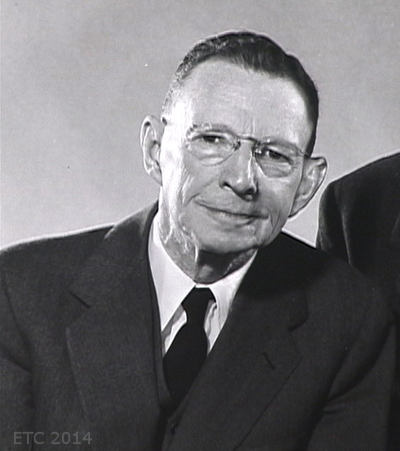
Dr. W. D. Coolidge (1873-1975) was one of the most important innovators of the 20th century. Coolidge developed the ductile tungsten filament used in lightbulbs, fluorescent lamps, car ignitions and vacuum tubes. He worked on transformers and cathode ray tubes, high vacuum tubes and he was one of the early leaders at the General Electric Research Lab. He had a remarkable understanding of physics and made improvements to many technologies.
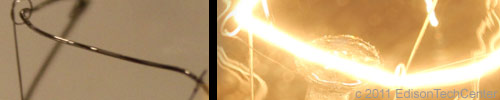
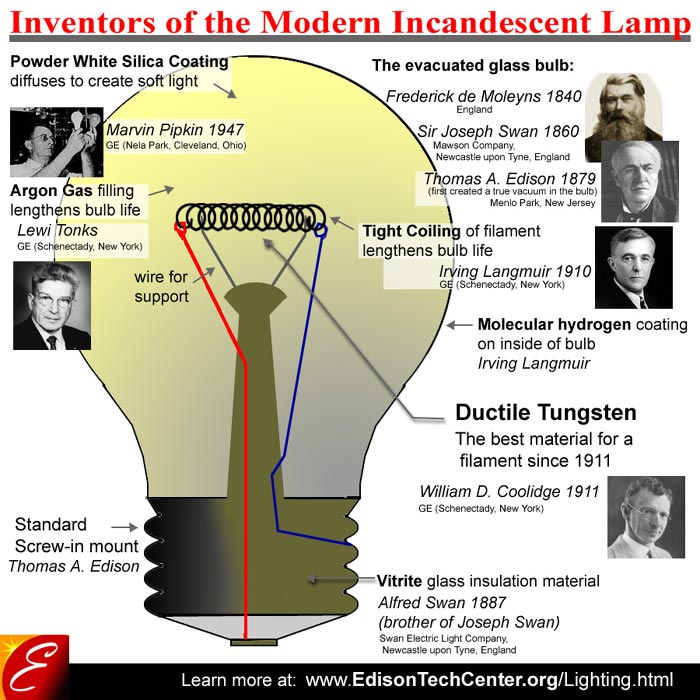
Tungsten filaments replaced tantalum filaments in 1911 and have reigned as the filament of choice ever since. Before Coolidge's work lightbulb filaments were made with more fragile sintered tungsten, tantalum, bamboo or carbon. Ductile tungsten allowed the bulb to last longer and produce brighter light.
Condensed Biography:
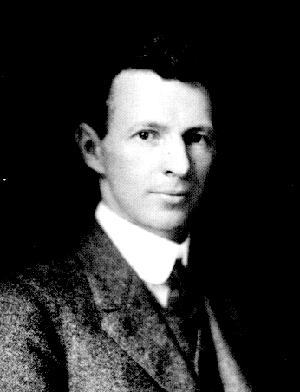
A young William Coolidge |
|
Once he had solved the riddle of the incandescent lamp, Dr. Coolidge began investigating the applicability of ductile tungsten to X-ray tubes. He devised a technique for vacuum-casting copper in good thermal contact around a tungsten disk to conduct the heat away. Tungsten was universally used for targets, except in a few tubes used for special purposes.
Vacuum Tubes, X-rayThis however, was far from his greatest contribution to X-ray science. When Dr. Irving Langmuir demonstrated the possibility of a pure electron discharge in high vacuum, Dr. Coolidge perceived the possibility of a radically new type of X-ray tube. This Coolidge X-ray tube soon substantially superseded all previous types. The use of X rays became a science instead of an art. During the first World War he developed a device known as the "C" (for Coolidge) tube for detecting submarines. This was followed by the development of a second detector, known as the "K" tube, which was a drifter set, free from the water noises that reduced the range of the "C" tube in rough weather. But the "C" tube was only one of Dr. Coolidge's contributions to the war effort. His other was the development of a small, powerful portable X-ray generating system for use in field hospitals. This system, in turn, led to the development of one so small, light and readily assembled that a doctor could easily transport it and set it up at a patient's bedside. |
|
Vacuum Tubes >
X-ray for Dentistry, Cathode Ray Tubes
Another development was a very small self-shielded, self-rectifying tube, and a small 56,000-volt transformer, both of which could be placed in an oil-filled, tightly sealed case. This permitted for the first time a wholly safe, convenient and adequate X-ray outfit for the dentist. Along with this development of X-ray tubes, Dr. Coolidge carried on studies of high-powered cathode rays. He became assistant director of the General Electric Research Laboratory in 1908, associate director in 1928, director in 1932 and vice president and director of research in 1940. In December 1944 Dr. Coolidge retired as vice president but continued in a consulting capacity. In September 1946 he returned as head of the new division of the Research Laboratory at the Hanford Engineer Works, Richland, Washington.
Among his many awards are the following:
- Rumford Medal of the American Academy of Arts and Science
- Howard N. Potts Medal of the Franklin Institute
- Louis Edward Levy Gold Medal of the Franklin Institute
- Gold Medal of the American College of Radiology
- Hughes Medal of the Royal Society, London
- Edison Medal of the American Institute of Electrical Engineers
- Washington Award of the Western Society of Engineers
- John Scott Award
- Faraday Medal of the Institution of Electrical Engineers of England
- Modern Pioneer Award of the National Association of Manufacturers
- Duddell Medal of the Physical Society, London
- "Order del Mento" by the Chilean Government
In 1937 he received from the University of Zurich an honorary M.D. degree in acknowledgement of his outstanding achievements in the field of applied physics in medical science, particularly in the field of X-rays. He was also awarded Doctor of Science degrees from Union College (1927) and Lehigh University (1927).
 |
|
He was an honorary member of the American Roentgen Ray Society, the American Radium Society, the Radiological Society of North America, the American College of Radiology, the Dental Society of the State of New York, the Roentgen Society (of England), The Societe de RAdiologie Medicale (de France), and the Nordisk Forening for Medicinisk Radiologi (Scandinavia).
When Coolidge died in Schenectady in 1975 at the age of 101, he held a total of 83 patents. He was well loved by his community and coworkers. He had provided a venerable voice in the tight-knit community of the research and engineering labs often called "the GE Family".

Edison Tech Center
General Electric
Schenectady Museum (MiSci) Hall of History archives
Sources:
Edwin Reilly Jr.
The General Electric Story. by Bernard Gorowitz. 1999
If you are a historian and wish to correct facts or publish a commentary or embedded article feel free to contact us.
Photos:: Permission and fees are required for use of photos in printed or internet publications.
Educational Use:: Students and teachers may use photos and videos at school. Graphics and photos must retain the Edison Tech Center watermark or captions and remain unmanipulated except for sizing.
Republication of any part or whole of any ETC video requires a professional license agreement. Contact us for legal permissions and fees.