

Semiconductors
The Foundation of Modern Electronics
1.) Basics
2.) Important Semiconductor Devices
2.a) Power Conditioning: Thyristors: SCRs, Triacs, Diacs
2.b) Other Uses: Diodes, Transistors
3.) Materials
4.) History Timeline
5.) Featured Pioneers
1.) Basics
What is a Semiconductor?Semiconductor materials are materials with that allow electricity to pass through due to electron flow. In contrast, normal conductors have ionic conductivity. Various elements are semiconductors. One of the first to be experimented with was germanium (Ge) (Element # 32). Silicon and Gallium are more well known semiconductors today.
Semiconductors are so universal in application due to the ability of humans to precisely control how these materials conduct electricity: by controlling crystal size of the element and doping one can achieve desired resistively.
Doping is introducing certain impurities into a pure sample of semiconductor to achieve desired properties. Doping a semiconductor to high levels makes the material act more like a conductor, this is called degenerate. A lightly doped semiconductor is called extrinsic. There are many methods of doping materials and it is a highly complex area of study.
To understand p-n junctions and semiconductors better you will need to invest a good amount of time in a lecture, it is not a simple phenomena and far too lengthy to cover here. See a 59 minute introduction lecture to solid state (semiconductors) from ITT Madras here.
The Future:Semiconductors are the basis of consumer electronics today and will continue to be vital long into the future. Technologies which will replace many semiconductor electronics will be carbon nanotube based electronics and artificial diamonds. The military and NASA use diamonds instead of silicon wafers because they are less prone to damage by harmful rays in space. Solid state technology used in our power grid and electronics is prone to damage during solar flare events or other electromagnetic pulse events.
Construction:
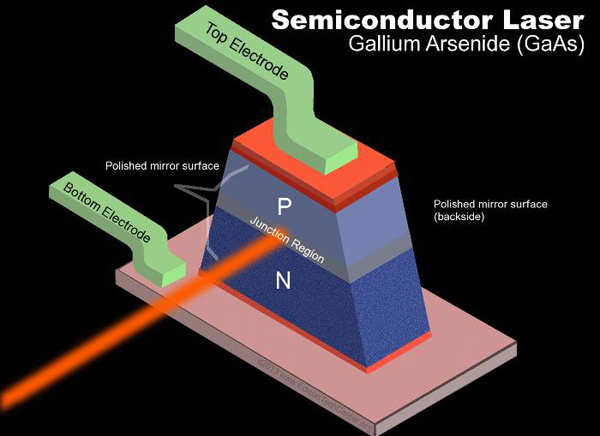
Semiconductor devices consist of one or more p-n junctions. In the graphic below you see a simple semiconductor device consisting of a single crystal of gallium arsenide. The n region may be doped with Tellurium and the p region may be doped with zinc. There are many materials that can be used for doping. We have a video on how this works here.
Important Semiconductor Devices:
2.a) Power Conditioning: Thyristors: SCRs, Triacs and Diacs
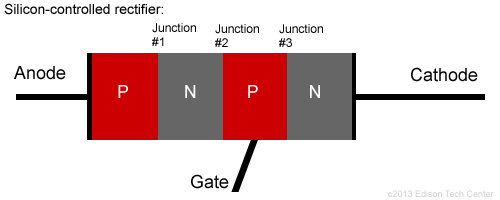
(control and manipulation of power to do a given job):Thyristors - a family of semiconductor devices used to do many jobs. It is used in HVDC power transmission and contains at least 4 layers of n and p-type semiconductor layers (PNPN device). SCRs, Diacs and Triacs are forms of thyristors.
Rectification - allowing current in only one direction. Diodes and Thyristors are rectifiers.
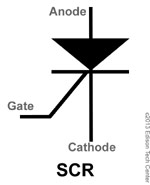
SCR - Silicon-controlled Rectifier - One device that can do the job of a relay, switch, circuit breaker, magnetic amplifier and many more. The SCR is a controlled half wave rectifier. It is used with medium to high powered AC power - from lamp dimmers to motor control to power transmission. The SCR allows current to only go in one direction, like a diode, except that it only allows current to pass through when it is at a desired level. A diode allows all current to go through as long as the anode stays positive.
The SCR is either 'on' or 'off'. When a current is applied on one end it rises, when it reaches a given value it is allowed to pass through the device. When the current drops below "holding current" the SCR completely blocks the current. When the current reverses the SCR blocks that as well.
Parts:
Anode - (+)
current flows in from this side, electrons move out from this side
Cathode - (-) current flows out from this side.
Gate - the device can be turned on or off by the gate
You can see that by controlling the value of when current is blocked, the wave form is chopped. By allowing less current to pass you can reduce the amount of power going to an electric motor, slowing it down. Another thing you can do is convert AC to DC power such as at the interface where AC power meets an HVDC transmission line.
This was an improvement in that mechanical or mercury arc switches result in an arc being formed as the two conductors physically approach. This arc would send a dangerous voltage spike which could damage sensitive electronics. Another improvement is that the SCR stops current from "leaking" through when it is in the off state. This device was one of the most important early developments in electronics. First built by Bob Hall at GE, based on rudimentary work of PNPN devices at Bell Labs.
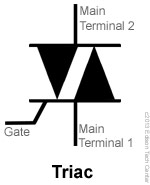 |
Triac
- Used as a trigger for SCRs. Similar to an SCR except that it can
do full wave rectification. Concept developed by Bill Gutzwiller and built by
Gordon Hall (GE)(1957).
Learn more about triacs here > |
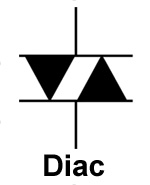 |
Diac - (Diode for Alternating Current). Like an SCR except that it works in both directions. It doesn't conduct until a breakover voltage is released, then it conducts until current drops below a certain threshold. When the polarity reverses it will work the same way again. |
The other signal diode, called diac, is a low voltage device used primarily to gate SCRs and triacs but is not capable of carrying any particular power.
There are other diacs formally known as quadracs (a diac-triac combination) and alternistors. Today the devices are now available up to 3000 amps and 10k volts with at least 25 different structures.
Learn more about diacs here >
2.b) Other Uses: Diodes and Transistors:
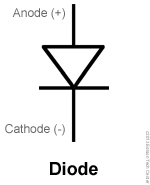 |
Diode - Can
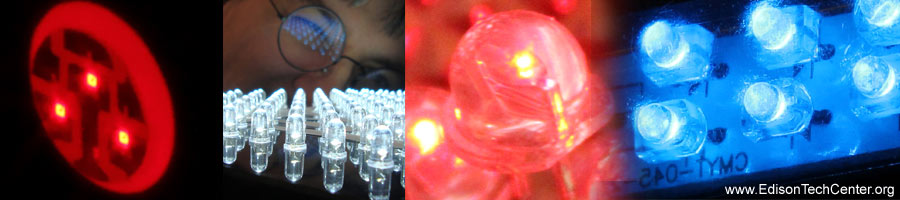
be made with semiconductors, or as a vacuum tube. It can convert AC to DC, it is also used to detect VHF, UHF signals and as a meter rectifier. The first semiconductor type was made with Germanium. Applications and types: tunnel diode, LEDs, laser, and learn more about the many kinds of diodes > |
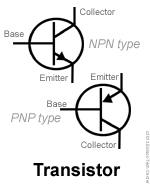 |
Transistor - operates like a switch and/or amplifier. For a good explanation of how they work go here > |
|
|
|
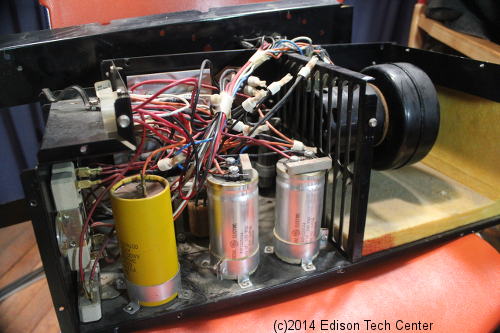
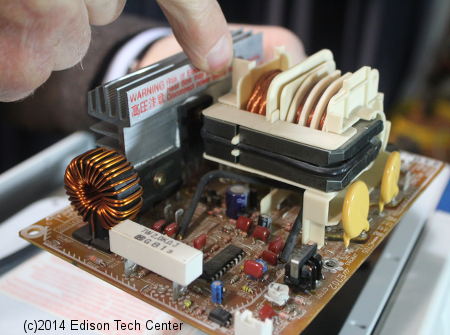
More
Applications and Devices:
There are too many applications of the material to list, however you
can click on the following links to see related pages and videos on
the Edison Tech Center web site.
| How the Semiconductor Laser Works | CMOS photo imaging Chip |
| The Metal Oxide Varistor (MOV) | Purifying Germanium with Dr. Robert Hall |
| LED (Light Emitting Diode) | Solid State switches in HVDC |
3.) Materials:
Learn about the many materials on the Periodic Table which are semiconductors:
Germanium
Silicon
Indium
Galena
More
Below video: basics of making integrated circuits on silicon wafers (part of our Copper in our Electrical World Series).
4.) History:
Major events and dates:
1906 - First semiconductor device: 'Cat's Whisker' detector developed - uses wire in close contact with Galena
1925 - Field-effect transistor idea developed by Julius Edgar Lilienfeld, but he could not build a working model due to substandard materials.
1934 - Oskar Heil also develops a field-effect transistor
1947 - Bardeen and Brattain discover amplification effect in germanium at Bell Labs. This is the first point-contact transistor
1948 - Point-contact Transistor also discovered independently in Germany
1949 - Werner Jacobi makes the first "integrated circuit" made of 5 transistors
1953 - First transistor sold commercially by Philco
1954 - First silicon transistor made by Texas Instruments
1955 - First all transistor car radio made by Philco
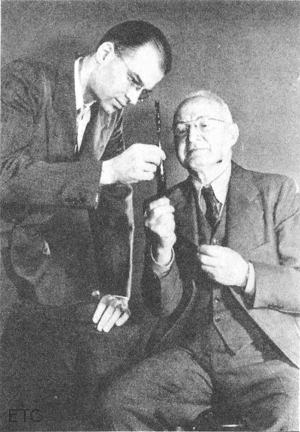
Above: Bob Hall (left) and Saul Dushman look at a large single germanium crystal at General Electric. Hall's work led to great improvements in the transistor, meanwhile in the same GE labs vacuum tubes were reduced from fragile, large glass tubes to ceramic, durable pea-sized cylinders. GE Management chose to go put their wait behind the new small vacuum tubes. Bell Labs ended up winning in this battle as solid state replaced tubes.
1956 - Thyristor first commercially available
1957 - Gordon Hall and Frank W. (Bill) Gutzwiller develop the SCR (silicon controlled rectifier)
at General Electric.
Gutzwiller drew the idea on paper while Hall built it and according to some deserves the credit.
Gordon Hall at the Clyde facility
of the Semiconductor Products Department was challenged by
his manager Ray York to see if he could an SCR which had only been theorized at that point. He was successful
however Bob Mooney (patent attorney) felt that defending the application would cost so much
that it would not be something that the SPD could afford to do.
Please note that many people helped
develop this technology at Bell Labs and General Electric. Nick Holonyak and Dick Aldrich
left Bell Labs and were sent to the Advanced Semiconductor Lab at GE Syracuse under
the direction of Harris Sullivan. As with the MRI and other technologies there has
been much controversy over who invented the device. "Bill [Gutzwiller] was manager of
Application Engineering and had suggested that it would be wonderful to have a rectifier with a
control electrode. But such suggestions do not constitute invention, nor reduction to
practice."
1958 - Texas Instruments makes the first real "integrated circuit" consisting of one piece of semiconductor material with multiple components inside it.
1960 - First MOS - metal-oxide-semiconductor field-effect transistor
5.) Featured Pioneers:
Bell
Labs:
John Bardeen (Transistor)
William Shockley (Transistor)
Walter Brattain (Transistor)
Fred Seitz (solid state physics)
Gordon Teal and Morgan Sparks
- developed the double doping method used in germanium
John Moll - PNPN switch (lead
to the SCR)
Carl Frosch - discovered Silicon Dioxide Masking
Morris Tanenbaum -
More names will be added over time here
General
Electric:
Robert N. Hall - Semiconductor laser,
Transistors, SCR, invented the alloy diffusion process. Schenectady
Order our full video interview with him. Show # T007. Donate
to get this on DVD.
William Dunlap -
Crawford Dunlap - germanium doping, alloy diffusion process improvements
Nick Holonyak - red LED,
Triac, metal thin film technologies. (also worked for Bell Labs). Syracuse
Richard Aldrich - Triac.
Syracuse
Ray York - Triac. Syracuse
Finis Gentry - Triac. Syracuse
Bernie Bedford - SVC - Static
VAR Compensator. Schenectady
Bill Gutzwiller - inventor of the Triac, SCR - Silicon Controlled Rectifier.
Clyde
John Harnden Jr. - GEMOV - Metal Oxide Varistor and power conditioning,
SCRs. Schenectady.
Bill Morris - GEMOV - Metal Oxide Varistor. Schenectady
Fracois Martzloff - GEMOV
Joe Wong - GEMOV
William Kornrumpf - SCRs. Schenectady
John Saby - alloy junction
transistor - Syracuse
Addison Sheckler - improved Diodes through crystallization techniques
- Syracuse
Jerry Suran - Double Base Diode. Syracuse
RCA:
Jacques Pankove - alloy junction
transistor
Texas Instruments:
Gary Pittman (First LED,
infrared)
Bob Biard (First LED, infrared)
Monsanto:
George Craford (Yellow LED)
Other Companies/Universities:
Shuji Nakamura (Blue LED)
Robert Noyce - Triac
Werner Jacobi
Featured videos on the history of semiconductors:
The GE Semiconductor Business, Oral History with Dr. Oliver Winn - Former manager of the General Electric microprocessing division
Related Topics:
Lasers |

Lightning and Surge Arrestors |

Photovoltaics |
12 Major Forms of Electric Light |
Capacitors |

More Stuff |
Article by M.W. & J.Harnden
Sources:
Semiconductor
Research and Development at General Electric, by Mark P.D. Burgess
Video Interview
with Robert Hall, by Edison Tech Center. 2008. Show # T007
LEDs and OLEDs, by Edison Tech Center. 2012
Wikipedia: Transistors, Diodes, Triacs
Oliver Winn - Electrical Engineer
Bipolar Junction Transistor Theory by Chuck McManis. 2003.