

Mechanicville Power Plant 1897
The world's oldest 3 phase power plant still in operation
Built by by C. P. Steinmetz, it was in the first generation of 3-phase AC power plants in the world
The generators still run today at 40 Hz. In the 1890s there was not standard in frequency, 25, 40, and 60 Hz facilities existed.
A Dazzling Feat! - Over 1000 tourists each day came to view the construction of the power station in 1897Hydroelectric backgroundHydropower had been used long before electricity, so it came natural to early inventors to attach DC generators to a water wheels in the 1870s. The main problem was that until the 3-phase AC generator, there was no way to transmit power a long distance (to downtown areas in cities for example). General Electric built the first 3-phase AC power plant in the Western Hemisphere in 1893 at Redlands, California. The same year another installation in Columbia Mills, South Carolina (The Pelzer Plant) provided the first full scale 3 phase electrification of a textile mill. Engineers Elihu Thomson and Steinmetz worked together to develop the world's first large 3 phase AC generators at Thomson-Houston and General Electric. Westinghouse independently pursued the 2 phase 25 Hz system which had it's roots in work by Siemens, Ferranti and others. In the end 3 phase proved to be the best system. Since power plants were very expensive to build, they were in places with economic interest. Mechanicville was important due to it's proximity to the General Electric plant in Schenectady and textile mills in Cohoes/Albany.
About this Power Generation Site:
Distinction: Oldest 3-phase AC hydro-power plant in continuous service, this site was used for experiments by AC pioneer Charles Steinmetz and later Albert W. Hull
Frequency: 40 cycle
Three-Phase, Alternating Current
Power Transmission Length: 19 miles
Power system built by: General Electric
Notable Engineers: C. P. Steinmetz, William Stanley, Elihu Thomson
Maximum Power Output: 5250 kW
Below: Video of the Mechanicville Hydroelectric Station
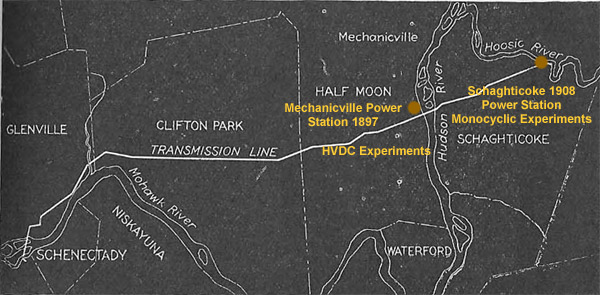
Why Mechanicville?The Schenectady economic industrial machine required enormous amounts of power, so the first place to look for hydropower was the Mohawk River. The Mohawk had large season variations and was insufficient. Mechanicville however is located on the powerful Hudson River about 19 miles away to the east. It is supplied year round by rain/snowfall in the Adirondack Mountains. The map below is from 1917 showing the Mechanic-Schenectady line with the extension to the Schaghticoke power station on the Hoosic River (This section was built later).
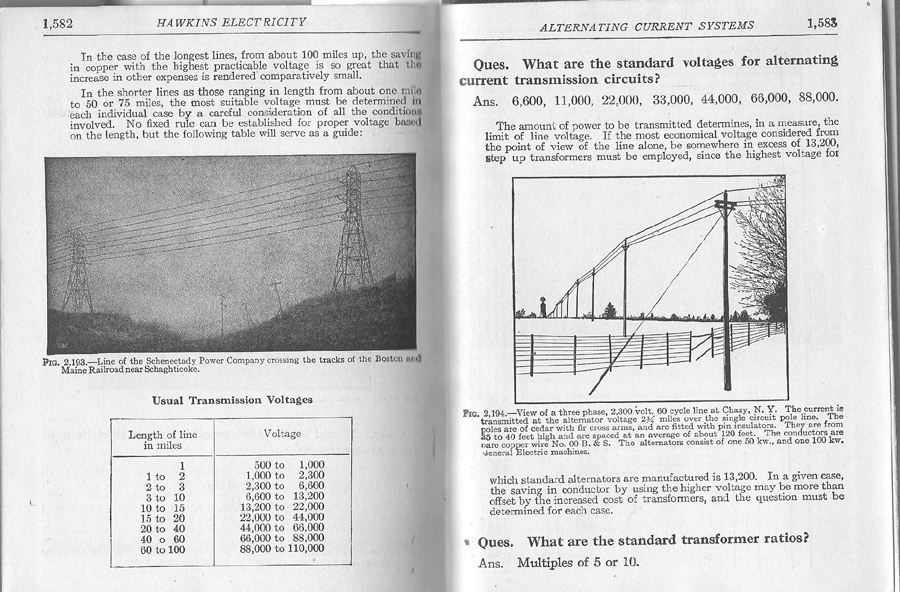
Course of the Schaghticoke-Schenectady transmission line through Mechanicville of the Schenectady Power Co. This Transmission line carries practically the entire output of the Schaghticoke power house to Schenectady, N.Y., a distance of approximately 21 miles. The line consists of two separate three phase 40 cycle, 32,000 volt circuits, each of 6,000 kw. normal capacity. These circuits start from the opposite ends of the power house, and, after crossing the Hossic River, are transferred by means of two terminal towers to a single line of transmission towers. The two circuits are carried on these on opposite ends of the cross arms, the three phases being superimposed. The power house ends of the line are held by six short quadrangular steel lattice work anchor poles with their bases firmly embedded in concrete, the cables being dead ended by General Electric disc strain insulators. This equipment is together with the lightning arrestor horn gaps and the heavy line outlet insulators mounted on the roof of the powerhouse.While each circuit carries only 6,000 kW under normal conditions, either is capable of carrying the entire output of the station; in this case, however, the line losses are necessarily augmented. This feature prevents any interruption of the service from the failure of one of the circuits. There are altogether 197 transmission towers, comprising several distinct types.
- Hawking Electrical Guide #5
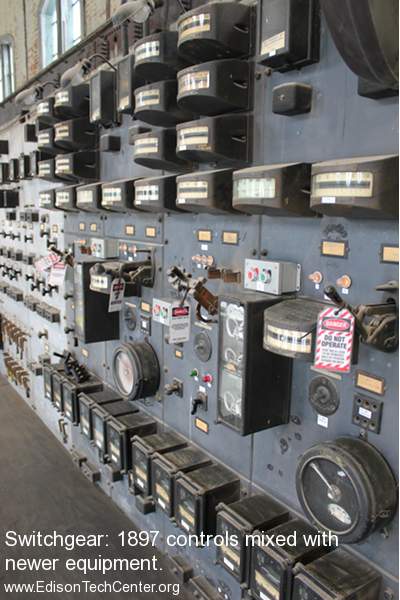
Left: Switchgear from 1897s on a slate panel mixed with newer equipment on marble panels
Just one year before Steinmetz and Thomson had worked on the system at Folsom, CA. The Folsom Powerhouse supplied Sacramento with power 22 miles away. This was the longest power transmission in North America at the time. This installation proved that the same system type could be installed in upstate New York.
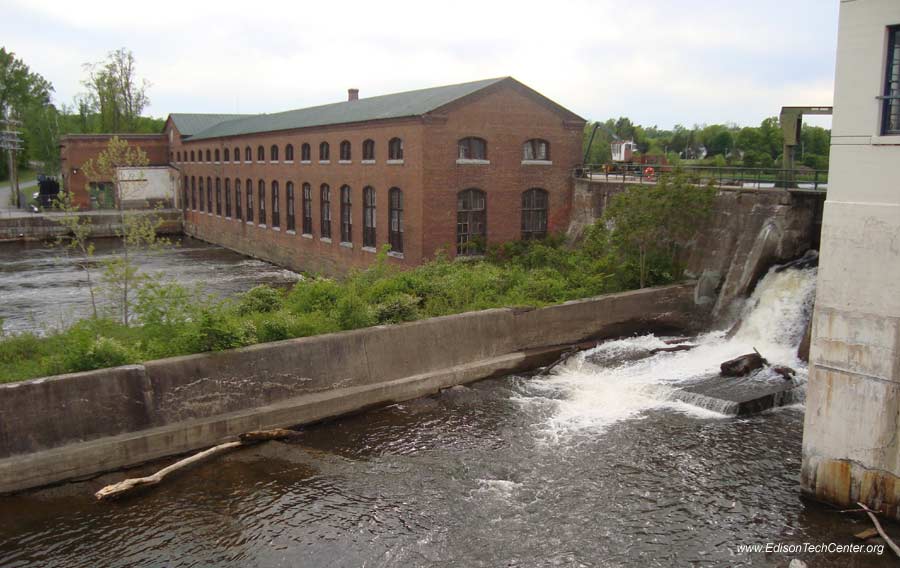
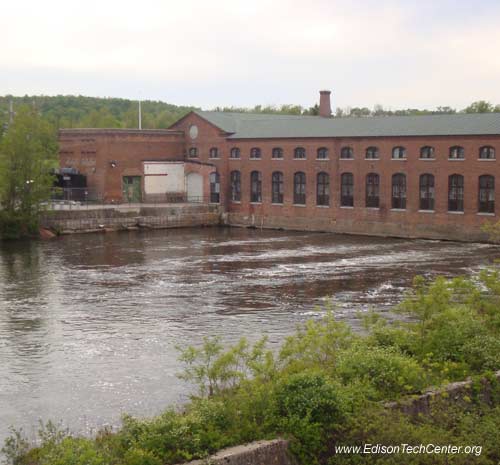
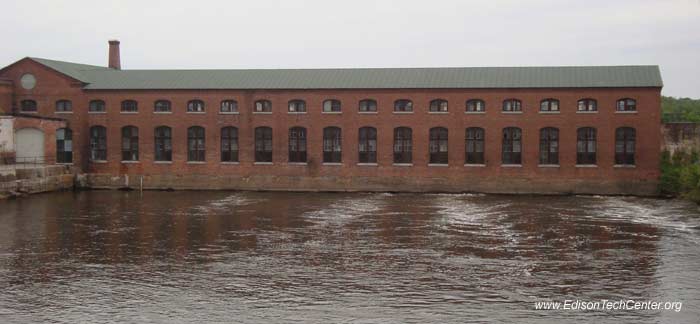
This consistent large volume of water was dammed just south of the city of Mechanicville and work began after 1895. The projected of this amazing massive project attracted crowds of 1000 each day. Electricity was a strange and magical concept at the time, and this became a spectacle.
After completion the powerhouse provided 7000 horsepower each day to Schenectady where it could be used by ALCO (American Locomotive Company) and General Electric.
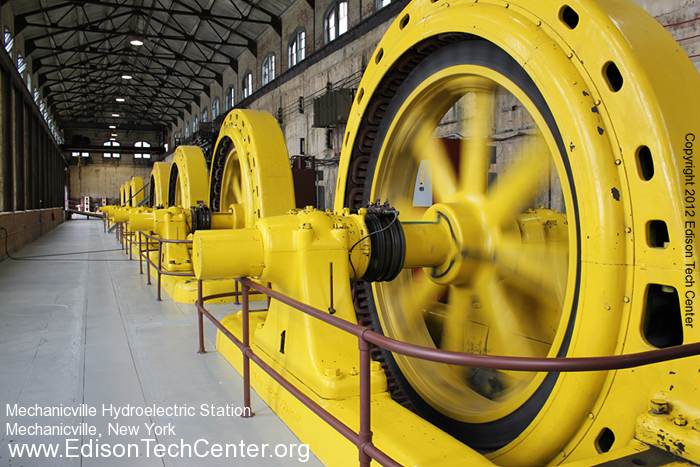
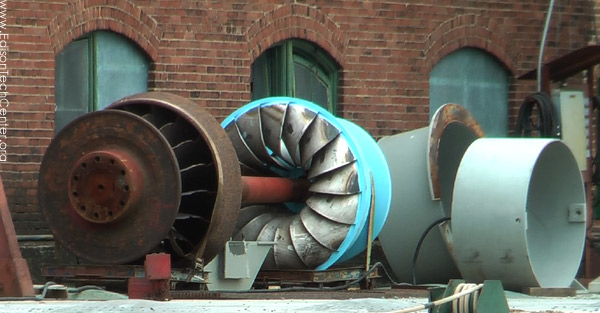
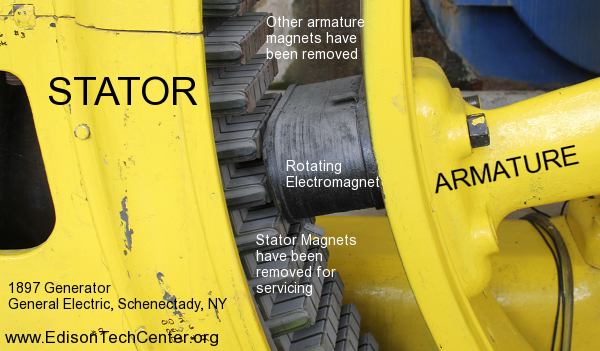
A single electromagnet on the armature exposed while the unit is under service, normally there would be many next to it, as well as electromagnets on the stator. All of the electromagnets on the stator side in this photo have been removed.
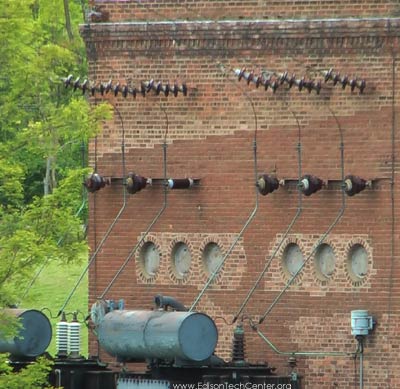
Right:
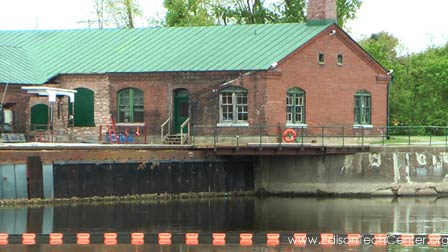
notice the round holes which at one time held outlet bushings for the
high tension lines. (These are not to be mistaken for air intakes on
other powerhouses.
Mechanicville
Hydroelectric Station transmitted 7000 horsepower each day to Schenectady
in the 1890's.
There are seven generators which provide 750 kW of power each.
You may visit the site as a tourist along with the adjacent DC power station at the lock. The power station is listed on the National Register for Historic Places since 1989.
We recommend you read more about the site in Dr. Paul Loatman's article "Harnessing the Hudson"
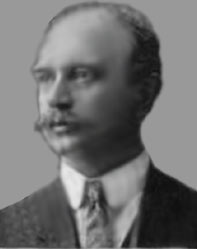
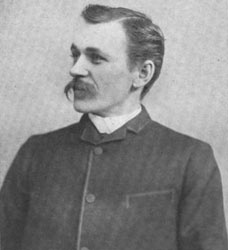
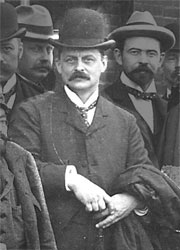
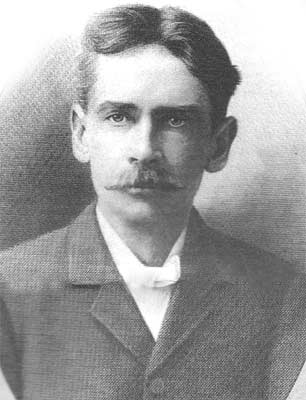
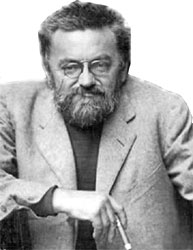
The General Electric Alternating Current Team (1890s):
A video which includes Mechanicville developments with others:
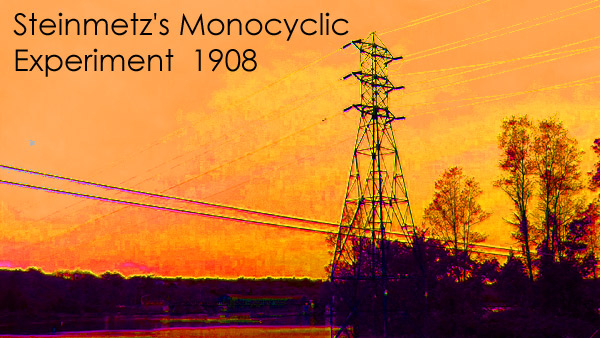
Steinmetz's Experimental Power Line 1908
Schaghticoke-Schenectady power line was a testing ground for new power grid technology
Read more about the experimental power line that went from Schaticoke to Mechanicville.Click Here to Continue
Schenectady GE Pioneer Albert W. Hull set up a DC transmission line with Schenectady.
Albert W. Hull is known for his invention of the magnetron (used in Radar, Microwave Oven, Etc.) but he also worked on high voltage DC power transmission. He set up a HVDC line from Mechanicville to Schenectady in 1932. GE tested mercury-vapor valves and a 12 kV DC transmission line which also converted 40 Hz to the modern 60 Hz system.Hull developed the Thyratron inverter, which is an ancestor of the silicon controlled rectifier used in modern HVDC systems world wide.
Monocyclic Power and HVDC, 1932The first system was tested at the plant in Schenectady:
"Three phase power at 550 V was converted into constant current by means of a three-phase version of the Steinmetz monocyclic network. This power was then stepped up and rectified to feed a 15,000 V artificial transmission line operating at a current of 10 A, allowing a transfer of to 150 kW of power. At the receiving end of this artificial line, a constant current Thyratron tube inverter was used to convert back to three-phase power. This was then stepped down and fed through a second monocyclic network. The 550V three-phase Schenectady shop power system served as a load for this experimental system." - Thomas Block, IEEEThen the system was tried as they built a HVDC transmission line from the hydro station at Mechanicville to Schenectady in 1936. (17 miles) The power was generated, then stepped up to 15 kV to ground, and the line was able to handle up to 5 MW.
Ernst Alexanderson lent some of his equipment for use in the building of the line. The Mechanicville-Schenectady HVDC line was used periodically for tests. GE did not end up going into the HVDC business after this test line. The line was torn down in the late 1940's.
Continued Research:
Multi-phase power transmission research continued over the years. Twelve-phase was the most ever created and that research was done by Dr. Oliver Winn at General Electric. The 12-phase system worked well when converted to DC, it made a smooth transition.The technical information was gathered by Rick Delair
and Steve Normandin of the Edison Tech Center
Other early hydro power plant links:
Back to History of Electrification and Transmission Page
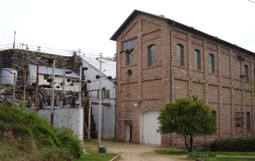
Folsom Powerhouse, Folsom California 1895
Redlands Mill Creek 1 powerhouse Redlands, CA 1893Dolgeville Dynamo Dolgeville Mill, Dolgeville, NY 1879
Great Barrington 1886 The first AC power distribution system using transformers
Schaghticoke Power Station and Steinmetz's monocyclic power experiment
References:
Hawkins Electrical Guide #5 Theo Audel and Co. 1917
Harnessing the Hudson by Dr. Paul Loatman
The General Electric Story by the Hall of Electrical History
Men and Volts by John Hammond
History of High Voltage Direct Current Transmission by Owen Peake
Monocyclic Power, A Novel but Short-Lived Power Distribution System by Thomas Block, IEEE
Marty Pickands, New York State MuseumPhoto/Video use:
Commercial entities must pay for use of photos/graphics/videos in their web pages/videos/publications
No one commercial or public is allow to alter Edison Tech Center photos/graphics/videos.
Educational Use: Students and teachers may use photos and videos for school. Graphics and photos must retain the Edison Tech Center watermark or captions and remain unmanipulated except for sizing.Permissions - Videos: We do not email, FTP, or send videos/graphics to anyone except in DVD form. Payment is needed for this service. See our donate page for pricing, and our catalogue for a listing of videos on DVD.
Professional video production companies may get videos in data form with signed license agreements and payment at commercial rates.
Copyright 2013 Edison Tech Center
 Home
Home